How to Formatting in DataGridView
The DataGridView control offers a high level of configurability and extensibility, providing developers with numerous properties, methods, and events to customize its appearance and behavior according to their specific application requirements.
While the DataGridView control allows for defining the basic appearance and formatting of individual cells and their values, it is common for multiple cells to share similar style characteristics. In such cases, it is more efficient to define appearance and formatting styles that can be applied to multiple cells.
DataGridViewCellStyle objects
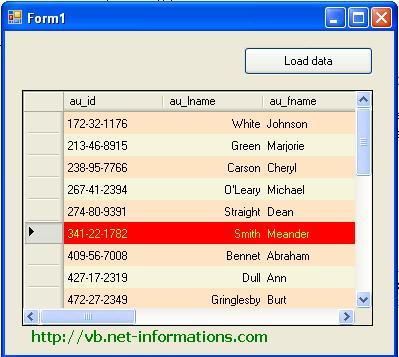
To achieve this, you can set the properties of DataGridViewCellStyle objects, which represent the styles for cells, accessed through various properties of the DataGridView control. These properties enable you to define appearance and formatting styles for individual cells, cells in specific columns and rows, or even for all cells within the control.
The following vb.net program shows how to implement different ways of cell formatting in a DataGridView control.
Full Source VB.NET- VB.NET DataGridView binding - Sql Server
- DataGridView binding - OLEDB in VB.NET
- DataGridView Sorting/Filtering in VB.NET
- DataGridView adding rows and columns in VB.NET
- DataGridView hiding rows and columns in VB.NET
- DataGridView ReadOnly rows and columns in VB.NET
- Adding Button to DataGridView in VB.NET
- Adding CheckBox to DataGridView in VB.NET
- Adding ComboBox to DataGridView in VB.NET
- Adding Image to DataGridView in VB.NET
- Adding ViewLink to DataGridView in VB.NET
- How to Paging in DataGridView
- How to DataGridView Template
- How to DataGridView Printing in VB.Net
- How to Export datagridview to Excel
- How to Import data from Excel to DataGridView
- Database operations in DatagridView
- Delete row from datagridview by Right click
- DataGridView Autocomplete TextBox in VB.Net